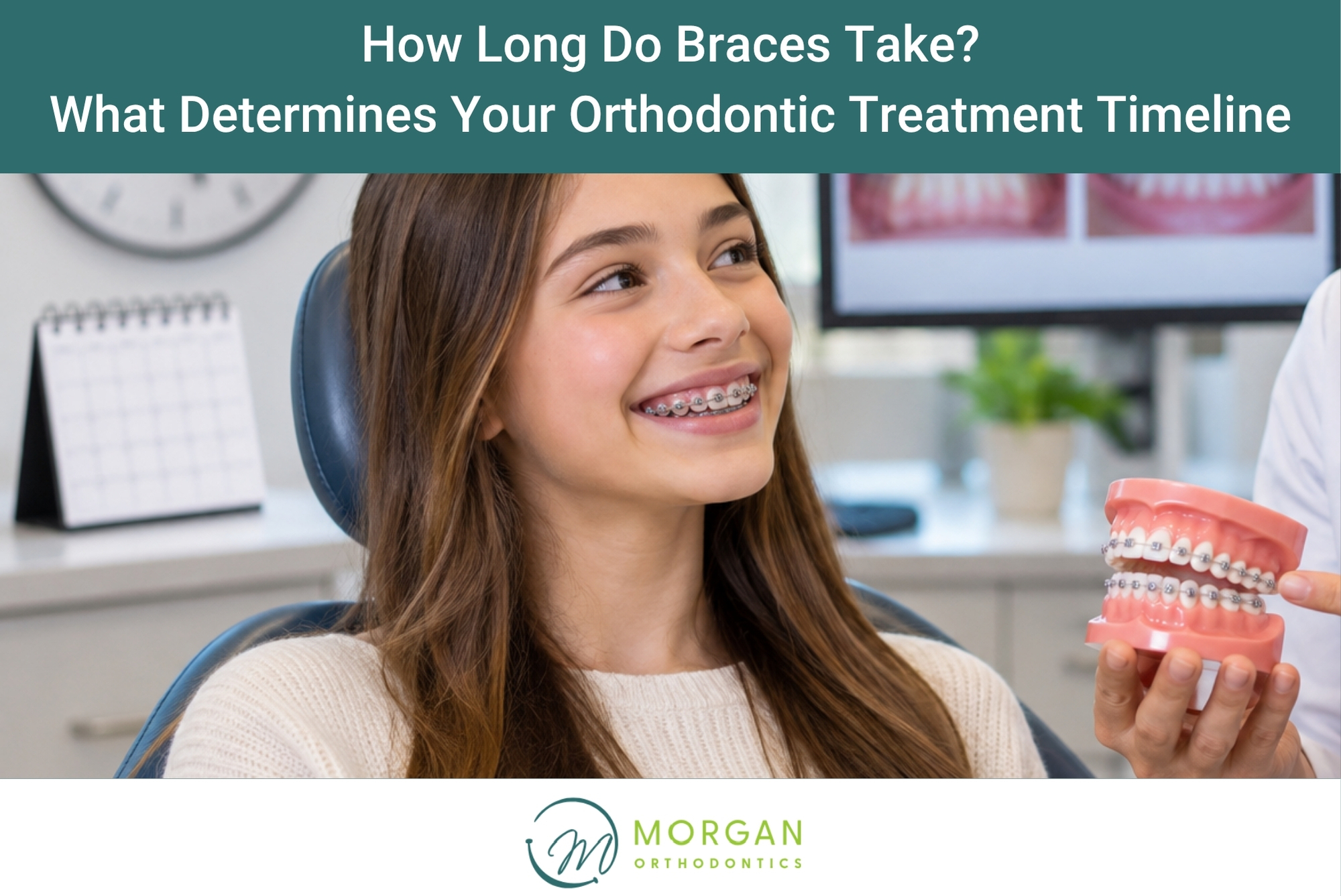
One of the first questions patients ask when considering braces is, “How long will I need to wear them?” The answer varies because orthodontic treatment is highly individualized. While some patients may complete treatment in approximately 12 months, others may need 18 to 24 months or longer to achieve the healthiest and most stable result.
For patients considering braces in Leesburg, VA, understanding what influences the orthodontic treatment timeline can make the process easier to anticipate. At Morgan Orthodontics, treatment planning considers much more than simply straightening visible teeth. Tooth position, bite alignment, jaw relationships, age, treatment goals, and patient cooperation can all influence how long braces are needed.
The objective is not necessarily to finish treatment as quickly as possible. It is to move the teeth safely and predictably while creating an attractive smile and a functional bite designed for long-term stability.
What Is the Average Treatment Time for Braces?
Most Comprehensive Orthodontic Treatments Take Approximately 12 to 24 Months
Many patients wear braces for approximately 12 to 24 months, although individual treatment times can be shorter or longer.
A relatively straightforward case involving minor crowding or spacing may require less time. More complex orthodontic problems involving significant crowding, bite discrepancies, impacted teeth, tooth rotations, or substantial tooth movement can require additional treatment time.
An orthodontic evaluation is the best way to receive a personalized estimate.
Every Orthodontic Case Is Different
Two patients who appear to have similar smiles may have very different orthodontic needs. One may primarily need cosmetic alignment, while another may have an underlying bite problem that is not immediately obvious.
Orthodontists evaluate the entire dental and facial relationship when developing a treatment plan. This comprehensive approach helps determine what needs to be corrected and how much time may reasonably be required.
What Determines How Long Braces Take?
The Severity of Crowding
Dental crowding occurs when there is insufficient space for the teeth to align properly. Mild crowding may require relatively limited movement, while severe crowding may require considerably more planning and treatment.
The orthodontist must create or manage appropriate space before positioning the teeth correctly. The greater the amount and complexity of movement required, the more treatment time may be necessary.
Gaps and Spacing Between Teeth
Spacing problems can also affect treatment duration. Small spaces may close relatively quickly, but larger or multiple spaces can require additional time.
The orthodontist must also consider why the spaces developed. Tooth size, missing teeth, jaw size, and other factors may contribute to spacing and influence the treatment strategy.
Bite Problems
Orthodontics addresses more than crooked teeth. Problems such as overbites, underbites, crossbites, and open bites can affect chewing, dental function, tooth wear, and long-term oral health.
Correcting a bite problem frequently requires more complex tooth movement than simply aligning the front teeth.
How Far the Teeth Need to Move
Orthodontic treatment works by applying carefully controlled forces to the teeth. These forces stimulate biological changes in the tissues and bone surrounding the tooth roots, allowing the teeth to gradually move into new positions.
Because this process must occur safely, teeth cannot simply be moved as quickly as possible. Larger movements generally require more time than minor adjustments.
Tooth Rotations
Some teeth are significantly rotated within the dental arch. Correcting substantial rotations can require additional treatment time because the orthodontic appliance must gradually reposition the tooth while maintaining appropriate control.
Impacted or Ectopic Teeth
An impacted tooth is one that has not erupted normally into the mouth. Certain impacted teeth, particularly canines, may require coordinated treatment involving orthodontics and sometimes another dental specialist.
Guiding an impacted tooth into its appropriate position can add time to an orthodontic treatment plan.
Does Age Affect How Long Braces Take?
Children and Teenagers
Children and adolescents are still growing, which can sometimes provide orthodontists with opportunities to guide jaw development and dental eruption.
Early identification of certain orthodontic problems can help determine the most appropriate time to begin treatment.
However, being younger does not automatically mean treatment will be faster. The complexity of the orthodontic problem remains a major factor.
Adults
Adults can achieve excellent orthodontic results with braces. Healthy teeth can respond to orthodontic forces at virtually any age.
Adult treatment may sometimes require additional considerations, particularly when a patient has existing restorations, missing teeth, periodontal concerns, previous dental work, or complex bite problems.
Patients searching for braces in Leesburg, VA should not assume they are too old for orthodontic treatment. A comprehensive evaluation can determine which treatment options are appropriate.
How Patient Cooperation Affects the Braces Timeline
Keeping Orthodontic Appointments
Regular orthodontic visits allow the treatment team to evaluate progress and make necessary adjustments.
Repeatedly missing or postponing appointments can extend treatment because the braces cannot be adjusted according to the intended schedule.
Wearing Elastics as Directed
Some patients are prescribed orthodontic elastics to help correct their bite. Elastics generally need to be worn according to specific instructions to produce the intended movement.
Inconsistent elastic wear can significantly slow treatment progress.
If your orthodontist recommends elastics, following the prescribed schedule is one of the most important things you can do to help treatment remain on track.
Taking Care of Braces
Broken brackets, damaged wires, and other appliance problems can interfere with planned tooth movement.
Patients should follow instructions regarding foods to avoid and contact the orthodontic office when an appliance becomes damaged.
Occasional problems do not necessarily create a major delay, but repeated breakages can extend the overall treatment timeline.
Maintaining Excellent Oral Hygiene
Good oral hygiene is essential throughout orthodontic treatment. Braces create additional areas where plaque and food particles can accumulate.
Patients should carefully brush around brackets and wires and clean between the teeth every day. Regular dental examinations and professional cleanings should also continue throughout orthodontic treatment.
Maintaining healthy teeth and gums helps orthodontic treatment proceed as safely as possible.
Can Braces Be Removed Early?
Removing braces before the orthodontic goals have been achieved can compromise the final result.
Teeth may look considerably straighter before treatment is actually complete. However, the orthodontist may still be correcting the bite, refining tooth positions, adjusting spaces, or working on details that contribute to long-term function and stability.
The final months of orthodontic treatment can be particularly important because this is often when detailed finishing adjustments are performed.
Can Orthodontic Treatment Be Made Faster?
Patients understandably want efficient treatment, but orthodontic tooth movement is a biological process. Applying excessive force does not necessarily make teeth move safely or predictably faster.
One of the best ways to avoid unnecessary delays is to follow the treatment plan consistently.
Patients can help by attending appointments, wearing elastics or other prescribed appliances correctly, avoiding foods that damage braces, maintaining excellent oral hygiene, and promptly reporting problems with brackets or wires.
Consistency is usually more valuable than attempting to accelerate treatment beyond what is biologically appropriate.
Why Your Estimated Braces Timeline Can Change
Teeth Do Not Always Respond Exactly as Predicted
Orthodontists develop treatment plans based on clinical examinations, diagnostic records, and established principles of tooth movement. However, individual biological responses vary.
Some teeth may move faster or slower than anticipated.
Growth Can Influence Treatment
For children and adolescents, growth and development can affect orthodontic treatment. Jaw growth, tooth eruption, and other developmental changes may influence the treatment timeline.
Unexpected Dental Issues Can Occur
Cavities, gum inflammation, dental injuries, or other oral health concerns may occasionally require attention during orthodontic treatment.
Maintaining routine dental care while wearing braces helps reduce the risk of preventable complications.
Why Finishing Orthodontic Treatment Properly Matters
The goal of orthodontic treatment is not simply to produce straight front teeth. A comprehensive treatment plan considers the relationship between the upper and lower teeth, tooth positioning, function, aesthetics, and stability.
Stopping treatment as soon as the smile appears straight may leave underlying orthodontic issues unresolved.
At Morgan Orthodontics, the treatment timeline is designed around achieving the planned orthodontic result rather than meeting an arbitrary deadline.
What Happens After the Braces Come Off?
Retainers Help Protect Your New Smile
Orthodontic treatment does not end when braces are removed. After teeth have been repositioned, they naturally have a tendency to shift.
Retainers help maintain the new tooth positions while the surrounding tissues adapt.
Your orthodontist will provide instructions regarding how and when your retainers should be worn.
Retainer Compliance Is Essential
Failing to wear retainers as directed can allow teeth to shift, potentially compromising the results achieved during orthodontic treatment.
Patients should think of retention as an essential part of maintaining their orthodontic investment.
Planning for Braces in Leesburg, VA
If you are considering braces in Leesburg, VA, your first step should be a comprehensive orthodontic evaluation.
During an orthodontic consultation, the orthodontist can assess tooth alignment, bite relationships, crowding, spacing, jaw development, and other factors. Diagnostic records may also be used to develop an individualized treatment plan.
Once the orthodontic needs have been identified, patients can receive a more accurate estimate of their anticipated treatment timeline.
Rather than focusing solely on how quickly braces can be removed, patients should consider the quality, function, and long-term stability of the final result.
Frequently Asked Questions About Braces and Treatment Time
How long do braces usually take?
Many comprehensive orthodontic cases require approximately 12 to 24 months, but treatment time varies significantly. Some relatively simple cases may take less time, while complex cases may require longer.
Can braces work in six months?
Certain limited orthodontic problems may be addressed in a relatively short period, but six months is not appropriate for every patient. Comprehensive bite correction and significant tooth movement commonly require more time.
Why is my braces treatment taking longer than expected?
Treatment may take longer because of complex tooth movement, bite correction, individual biological response, missed appointments, inconsistent elastic wear, broken appliances, or other factors.
Do braces take longer for adults?
Not necessarily. Adults can respond very well to orthodontic treatment. However, existing dental restorations, missing teeth, periodontal health, bone characteristics, and the complexity of the bite may influence treatment time.
Do braces work faster for teenagers?
Growth can sometimes help orthodontists address certain developmental or bite problems in younger patients, but treatment speed still depends heavily on the complexity of the individual case.
Can I ask my orthodontist to remove my braces early?
You can always discuss your concerns with your orthodontist, but removing braces before treatment goals have been completed may compromise alignment, bite correction, or long-term stability.
Do missed appointments make braces take longer?
They can. Regular appointments allow the orthodontist to evaluate tooth movement and make planned adjustments. Repeatedly missing appointments may delay progress.
Can broken brackets delay treatment?
Yes. A broken bracket may prevent the appropriate force from being applied to a tooth. Repeated appliance damage can increase overall treatment time.
Do orthodontic elastics make treatment faster?
Elastics are prescribed to accomplish specific tooth and bite movements. Wearing them exactly as instructed helps treatment progress according to plan. Inconsistent wear can delay correction.
Does tightening braces make teeth move faster?
Orthodontic treatment is not simply about making braces tighter. Orthodontists use controlled forces to guide teeth through bone safely. Excessive force does not necessarily produce faster or healthier movement.
How do I know when my braces are ready to come off?
Your orthodontist evaluates several factors, including tooth alignment, spacing, rotations, bite relationships, and overall treatment goals. Braces are typically removed when the planned correction has been achieved.
Will my teeth stay straight after braces?
Teeth can shift after orthodontic treatment. Wearing retainers according to your orthodontist’s instructions is essential for maintaining your results.
How can I keep my orthodontic treatment on schedule?
Attend appointments consistently, maintain good oral hygiene, follow dietary recommendations, wear elastics and other appliances as prescribed, and contact the orthodontic office promptly if something breaks.
How can I get an estimate for how long my braces will take?
Schedule an orthodontic evaluation. After examining your teeth, bite, and overall orthodontic needs, Morgan Orthodontics can develop an individualized treatment plan and provide an estimated treatment timeline.
Start Your Orthodontic Journey With Morgan Orthodontics
The amount of time you will need braces depends on your unique orthodontic needs. Crowding, spacing, bite problems, tooth position, age, biological response, and patient cooperation can all influence the treatment timeline.
For patients considering braces in Leesburg, VA, Morgan Orthodontics provides individualized orthodontic treatment designed to achieve healthy alignment, functional bite relationships, and lasting results.
A comprehensive orthodontic evaluation can help you understand what treatment involves, what factors may affect your timeline, and what you can do to keep your progress on track.
Contact Information
Morgan Orthodontics
Leesburg Office
19420 Golf Vista Plaza, Ste. 120
Leesburg, VA 20176
Phone: 703-723-5900
Winchester Office
1841 West Plaza Dr.
Winchester, VA 22601
Phone: 540-667-5446
Purcellville Office
610 E Main Street
Purcellville, VA 20132
Phone: 540-338-8125
Website: morganorthodontics.com
Call Us: (703) 723-5900