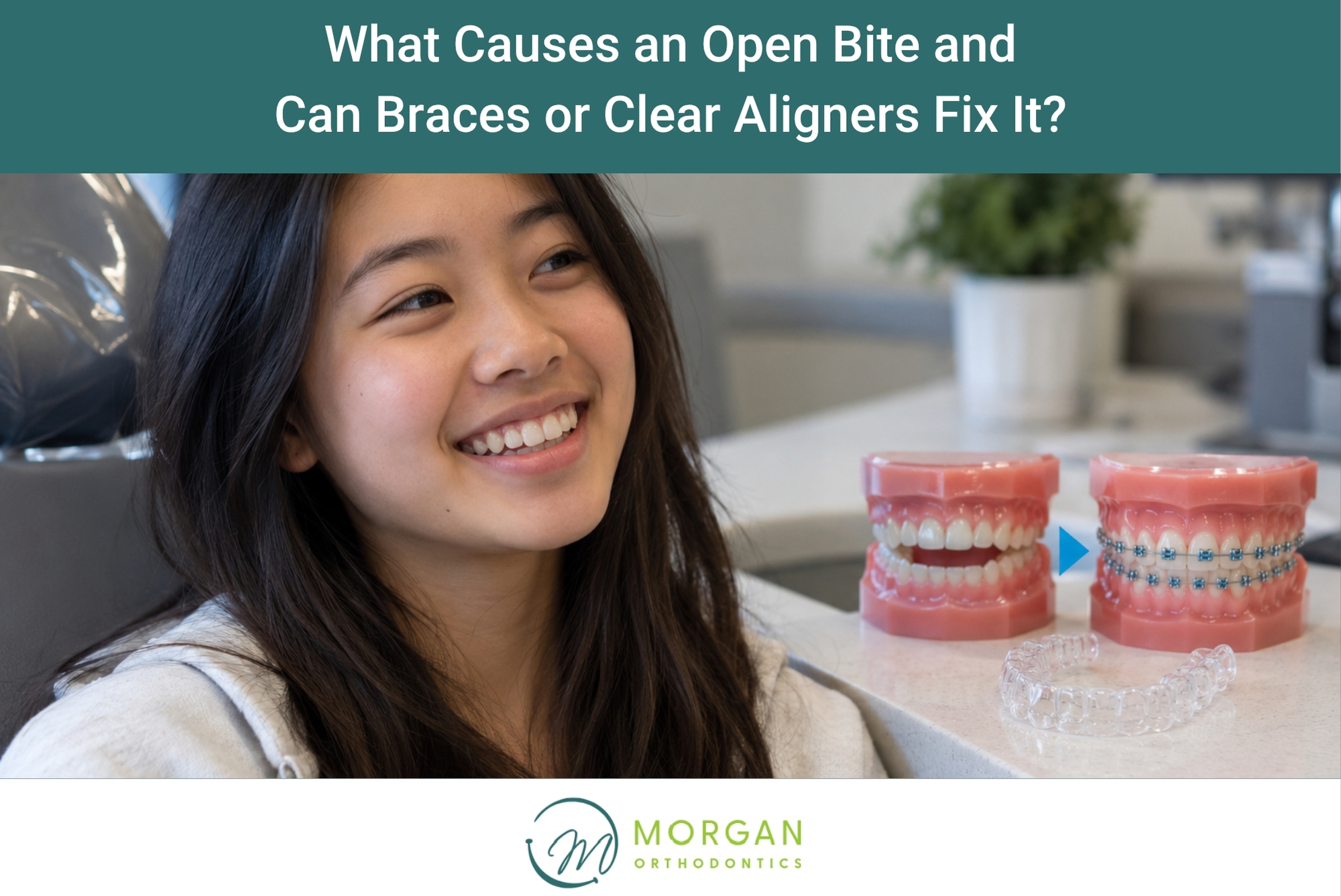
 An open bite is a type of malocclusion in which the upper and lower teeth do not make proper contact when the mouth is closed. Most commonly, an anterior open bite affects the front teeth, leaving a visible space between the upper and lower incisors even when the back teeth are together. Open bites can influence much more than the appearance of a smile. They may affect biting, chewing, speech, jaw function, and long-term oral health.
The causes of an open bite vary considerably from patient to patient. Genetics and jaw development can contribute, but childhood oral habits, tongue position, airway concerns, and other functional factors may also play a role. Because the underlying cause influences the appropriate treatment, a comprehensive orthodontic evaluation is essential.
For patients researching open bite treatment in Leesburg, VA, Morgan Orthodontics provides individualized orthodontic care designed to improve dental alignment, bite function, and smile aesthetics. Depending on the type and severity of the open bite, treatment may involve braces, clear aligners, additional orthodontic appliances, or, in certain severe skeletal cases, coordinated surgical care.
What Is an Open Bite?
An open bite occurs when certain upper and lower teeth remain separated while the jaw is closed. Although an open bite can develop in different areas of the mouth, the anterior form involving the front teeth is particularly common.
Anterior Open Bite
With an anterior open bite, the upper and lower front teeth do not overlap or contact properly when the back teeth are together. A noticeable vertical gap remains between them.
This can make it difficult to bite cleanly through foods such as sandwiches, pizza, fruits, or vegetables using the front teeth.
Posterior Open Bite
A posterior open bite occurs when teeth toward the back of the mouth do not contact properly despite other teeth coming together. This form can interfere with efficient chewing and the balanced distribution of biting forces.
Identifying the location of the open bite is only the first step. Orthodontists must also determine whether the problem is primarily dental, skeletal, functional, or a combination of these factors.
What Causes an Open Bite?
There is no single cause of every open bite. A careful orthodontic assessment helps determine why the bite developed and whether those contributing factors are still present.
Genetics and Jaw Development
Some open bites are related to inherited facial and skeletal growth patterns. The upper jaw, lower jaw, or both may develop in a way that creates excessive vertical growth and prevents the teeth from meeting normally.
Skeletal open bites can be more complex than open bites caused primarily by tooth position. Treatment recommendations therefore depend heavily on the patient’s age, growth status, and severity of the skeletal discrepancy.
Prolonged Thumb or Finger Sucking
Thumb or finger sucking is normal during infancy and early childhood, but a habit that continues while the permanent teeth are developing can influence tooth position and jaw growth.
Consistent pressure from a thumb or finger may push the upper front teeth outward while preventing the front teeth from erupting into their ideal positions. Over time, this can contribute to an anterior open bite.
Pacifier Habits
Prolonged pacifier use can affect the developing bite in a similar way. The risk depends on factors including the frequency, duration, and intensity of the habit.
This does not mean every child who uses a pacifier will develop an orthodontic problem. However, persistent habits should be discussed with a dental or orthodontic professional as the child’s teeth and jaws develop.
Tongue Position and Tongue Thrust
The tongue normally rests within the mouth and moves in a coordinated pattern during swallowing. In some individuals, the tongue consistently rests or pushes between the front teeth.
This pattern is often referred to as a tongue thrust. Persistent tongue pressure between the teeth may contribute to an open bite or make orthodontic correction less stable.
For this reason, correcting tooth position without addressing an underlying functional pattern may not always produce the most predictable long-term result.
Airway and Breathing Patterns
Chronic mouth breathing and certain airway concerns can sometimes be associated with altered tongue posture and facial growth patterns. Because multiple factors may contribute to an open bite, orthodontic evaluation should consider the patient’s overall oral and facial development rather than focusing exclusively on crooked teeth.
An orthodontist may recommend additional evaluation by another healthcare professional when airway, breathing, or related concerns warrant further investigation.
Abnormal Tooth Eruption
Sometimes teeth do not erupt into positions that allow proper contact with opposing teeth. Differences in tooth eruption, dental development, or tooth position can therefore contribute to an open bite even when the underlying jaw structure is relatively balanced.
Why Should an Open Bite Be Treated?
Not every open bite has the same severity or consequences. However, a significant open bite can create functional problems that extend beyond appearance.
Difficulty Biting Into Food
The front teeth are designed to help cut and tear food. When they cannot make contact, patients may compensate by using their back teeth or positioning food differently.
Correcting an open bite can improve the efficiency and comfort of biting.
Chewing Problems
An open bite can alter the way chewing forces are distributed across the teeth. Depending on the location of the bite problem, some teeth may receive greater pressure than others.
Creating a more balanced bite allows the teeth to work together more effectively.
Speech Concerns
The position of the teeth and tongue can influence the production of certain sounds. Some individuals with an open bite experience speech differences, including difficulty producing particular consonants.
Orthodontic treatment can improve the structural relationship between the teeth, although speech therapy may also be appropriate when an established speech pattern is present.
Uneven Tooth Wear
When teeth do not contact evenly, some teeth may experience excessive or abnormal forces. Over time, this can contribute to uneven wear.
Improving bite alignment helps distribute forces more appropriately throughout the mouth.
Smile Appearance
An open bite can significantly influence smile aesthetics, particularly when the front teeth remain separated. Orthodontic correction can improve tooth alignment and create a more harmonious relationship between the upper and lower teeth.
Can Braces Fix an Open Bite?
Yes. Braces can successfully treat many open bites, particularly when the problem is primarily related to tooth position.
Traditional braces give orthodontists precise control over the movement of individual teeth. Brackets are attached to the teeth and connected with orthodontic wires, allowing controlled forces to gradually reposition the teeth.
How Braces Correct an Open Bite
Depending on the patient’s needs, braces may be used to reposition the front teeth, adjust posterior tooth position, improve the relationship between the upper and lower arches, and create better vertical overlap.
Orthodontic elastics may also be incorporated into treatment. Elastics can provide additional forces between the upper and lower teeth to help guide bite correction.
Because every open bite has a different underlying structure, the exact mechanics must be individualized.
Can Clear Aligners Fix an Open Bite?
Clear aligners can also be effective for many open bite cases. Modern aligner therapy allows orthodontists to plan controlled tooth movements using a sequence of custom-made removable trays.
However, clear aligners are not automatically the best choice for every open bite.
How Clear Aligners Work
Each set of aligners applies carefully directed pressure to selected teeth. As treatment progresses, patients move through a prescribed series of aligners that gradually reposition the teeth.
Attachments—small tooth-colored shapes bonded temporarily to selected teeth—may be used to provide additional control.
Elastics or other orthodontic components may also be incorporated when necessary.
Who May Be a Good Candidate for Clear Aligners?
Clear aligners may be appropriate for adolescents and adults with certain mild, moderate, and even more complex open bites, depending on the cause and the movements required.
Successful aligner treatment also requires excellent patient cooperation because the aligners must be worn according to the orthodontist’s instructions.
The best way to determine whether aligners are appropriate is through a comprehensive orthodontic evaluation.
Braces vs. Clear Aligners for an Open Bite
Neither braces nor clear aligners are universally superior. The best option depends on the patient’s specific orthodontic diagnosis.
Advantages of Braces
Braces provide continuous orthodontic force because they remain attached to the teeth. They also offer excellent control over complex tooth movements and do not depend on patients remembering to wear removable trays.
For some complicated open bites, braces may provide advantages in treatment mechanics.
Advantages of Clear Aligners
Clear aligners are removable and less noticeable than conventional braces. Patients can remove them for eating, brushing, and flossing, which can make oral hygiene more convenient.
For appropriately selected open bite cases, aligners can provide both functional correction and an aesthetically discreet treatment experience.
Treatment Should Be Based on Diagnosis, Not Preference Alone
Patient preference is important, but orthodontic treatment should ultimately be selected according to the movements necessary to achieve a healthy and stable bite.
At Morgan Orthodontics, treatment planning considers the teeth, jaws, facial structure, growth pattern, bite relationship, and patient goals before recommending braces, clear aligners, or another approach.
Do Severe Open Bites Require Jaw Surgery?
Most people with an open bite do not automatically need jaw surgery. Many dental open bites can be treated orthodontically.
However, severe skeletal open bites in adults may sometimes involve jaw discrepancies that tooth movement alone cannot fully correct. In these situations, orthodontic treatment may be coordinated with orthognathic surgery.
Surgical treatment is generally reserved for carefully selected cases in which the skeletal relationship substantially contributes to the malocclusion.
Children and adolescents who are still growing may have different treatment possibilities because orthodontists can evaluate facial growth while development is still occurring.
Why Early Orthodontic Evaluation Can Be Helpful
An open bite can become apparent during childhood, particularly when oral habits or developing jaw relationships are involved.
Early evaluation does not necessarily mean a child will immediately need braces. Instead, it gives the orthodontist an opportunity to monitor dental and facial development and identify factors that could make the bite more difficult to correct later.
When a persistent sucking habit, tongue posture concern, eruption problem, or growth discrepancy is identified, early intervention may sometimes simplify future treatment.
Can an Open Bite Return After Orthodontic Treatment?
Open bites can relapse, particularly if the factors that contributed to the original problem remain after treatment.
Retainers Are Essential
After braces or clear aligners have moved the teeth into their corrected positions, retainers help maintain the new alignment while the surrounding tissues adapt.
Patients should follow their orthodontist’s retainer instructions carefully.
Underlying Habits May Need Attention
If tongue posture, tongue thrust, or another persistent oral habit contributed to the open bite, addressing that factor may be important for long-term stability.
In selected cases, coordinated care with another healthcare professional may be recommended.
Long-Term Orthodontic Follow-Up Matters
Orthodontic retention is an important phase of treatment rather than an optional extra. Teeth can continue to shift throughout life, even in individuals who never had an open bite.
Consistent retainer use provides the strongest defense against unwanted orthodontic movement.
Open Bite Treatment in Leesburg, VA
Patients looking for open bite treatment in Leesburg, VA should receive more than a quick assessment of whether their teeth appear straight. Effective treatment begins by determining why the teeth are not meeting properly.
Morgan Orthodontics evaluates the relationship between the upper and lower teeth, tooth position, jaw development, facial proportions, growth patterns, and other factors that can influence bite function.
Once the cause and severity of the open bite have been established, an individualized treatment plan can be developed. Depending on the patient’s needs, this may include braces, clear aligners, orthodontic elastics, other appliances, habit management, or coordinated care when appropriate.
The objective is not simply to close a visible gap. Comprehensive orthodontic treatment is designed to create a functional, balanced, attractive, and maintainable bite.
Frequently Asked Questions About Open Bite Treatment
What does an open bite look like?
An anterior open bite typically appears as a vertical space between the upper and lower front teeth when the back teeth are together. The amount of separation can range from subtle to pronounced.
Can an open bite correct itself?
Some bite changes associated with early childhood habits may improve after the habit stops, particularly while a child is young and still developing. However, persistent open bites involving permanent teeth, significant tooth displacement, or skeletal growth patterns often require professional orthodontic evaluation and treatment.
What age should an open bite be treated?
There is no single ideal age for every patient. Treatment timing depends on the cause of the open bite, the child’s dental development, remaining facial growth, oral habits, and severity of the problem. Adults can also receive successful open bite treatment.
Are braces effective for open bites?
Yes. Braces can be highly effective for many dental open bites. They allow orthodontists to precisely control tooth movement and may be combined with elastics or other orthodontic mechanics when necessary.
Can clear aligners close an open bite?
Yes. Clear aligners can successfully treat many appropriately selected open bite cases. The patient’s specific bite, treatment complexity, and ability to wear the aligners consistently all influence whether aligner treatment is appropriate.
Are braces better than clear aligners for an open bite?
Not necessarily. Both systems can be effective. Some cases are particularly well suited to braces, while others can be predictably treated with clear aligners. An orthodontic examination is necessary to determine which approach offers the best control for the required tooth movements.
How long does open bite treatment take?
Treatment time varies according to the severity and cause of the open bite, the orthodontic system used, the patient’s age and growth, the amount of tooth movement required, and patient cooperation. A personalized treatment estimate can be provided after an orthodontic evaluation.
Will I need rubber bands for an open bite?
Some patients require orthodontic elastics to help improve the vertical relationship between the upper and lower teeth. Whether elastics are necessary depends on the individual treatment plan.
Does tongue thrust cause an open bite?
Persistent tongue positioning between the teeth can contribute to an open bite in some patients and may affect long-term stability. Because tongue posture and open bites can have a complex relationship, individualized assessment is important.
Can thumb sucking cause an open bite?
Prolonged thumb or finger sucking can contribute to an anterior open bite, particularly when the habit continues during important stages of dental and facial development.
Does every open bite require surgery?
No. Many open bites can be corrected with orthodontic treatment alone. Surgery is generally considered only for selected severe skeletal problems, particularly in adults whose facial growth is complete.
Can adults have an open bite corrected?
Yes. Adults can receive open bite treatment with braces or clear aligners when orthodontic tooth movement can adequately address the problem. More severe skeletal discrepancies may require additional treatment considerations.
Will an open bite come back after braces or aligners?
Relapse is possible with any orthodontic treatment. Retainer use and management of contributing habits or functional factors are particularly important following open bite correction.
Can an open bite affect speech?
It can. Because the tongue, teeth, and airflow work together to produce certain sounds, an open bite may contribute to speech differences in some patients. Orthodontic treatment addresses the dental relationship, while speech therapy may be appropriate when additional functional treatment is needed.
How do I know which open bite treatment is right for me?
A comprehensive orthodontic evaluation is the most reliable way to determine the appropriate treatment. The orthodontist must assess whether the open bite is primarily dental, skeletal, functional, or a combination before recommending braces, clear aligners, or another treatment approach.
Schedule an Open Bite Evaluation With Morgan Orthodontics
An open bite is more than a cosmetic gap between the teeth. It is an orthodontic condition that can affect biting, chewing, speech, tooth wear, and overall bite function.
Modern orthodontics offers multiple approaches for correcting open bites, including traditional braces and clear aligners. The key is determining which treatment method can predictably address the specific cause of the malocclusion.
For patients seeking open bite treatment in Leesburg, VA, as well as those in Winchester, Purcellville, and surrounding Northern Virginia communities, Morgan Orthodontics offers personalized orthodontic evaluation and treatment planning.
A comprehensive examination can determine what is causing the open bite and which treatment approach is most appropriate for creating a healthier, more functional, and confident smile.
Contact Information
Morgan Orthodontics
Leesburg Office
19420 Golf Vista Plaza, Ste. 120
Leesburg, VA 20176
Phone: 703-723-5900
Winchester Office
1841 West Plaza Dr.
Winchester, VA 22601
Phone: 540-667-5446
Purcellville Office
610 E Main Street
Purcellville, VA 20132
Phone: 540-338-8125
Website: morganorthodontics.com
Call Us: (703) 723-5900