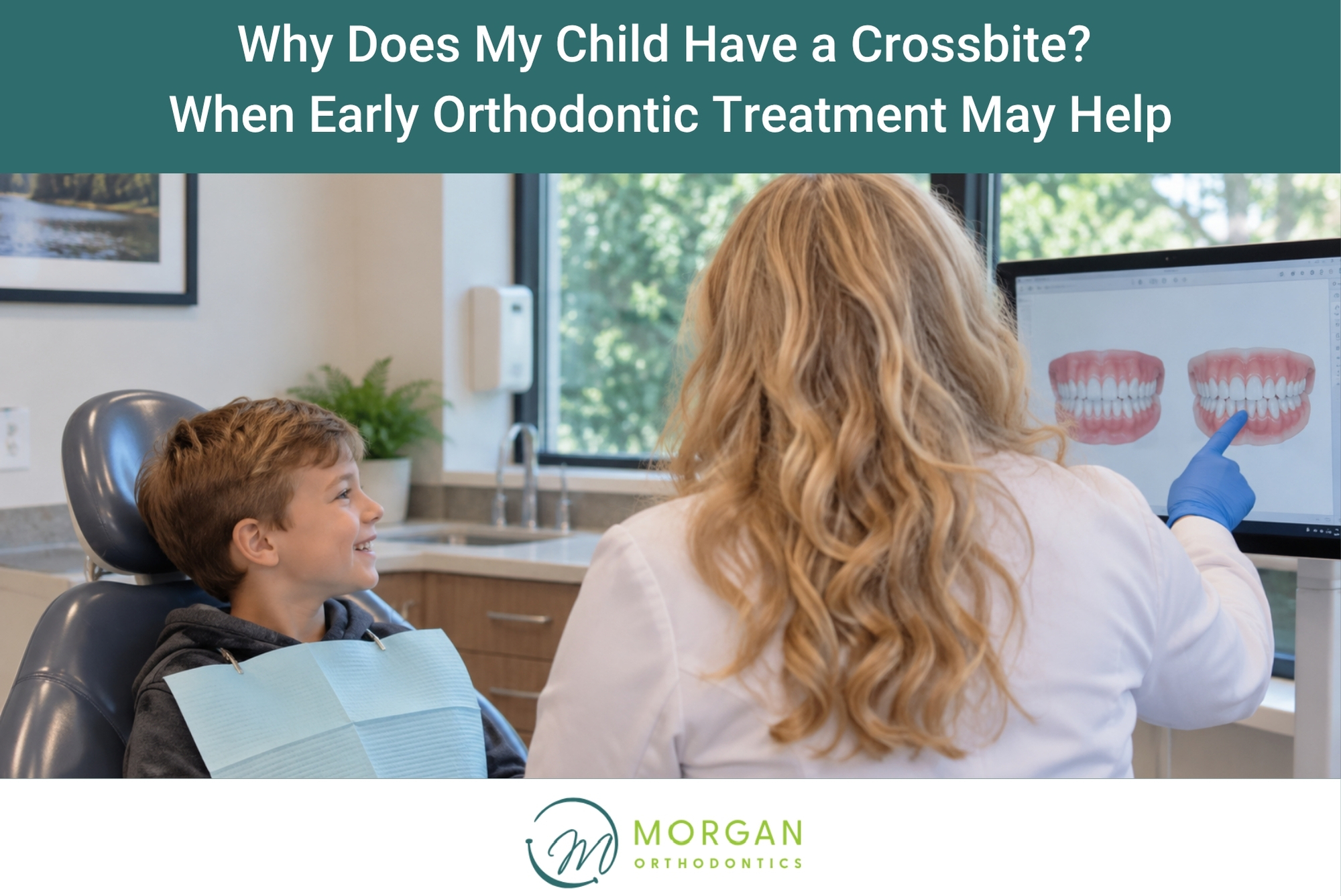
 A child’s smile, jaw, and bite undergo significant development throughout childhood. While some orthodontic concerns can safely wait until most permanent teeth have erupted, others may benefit from evaluation and treatment at an earlier age. A crossbite is one of the bite problems that orthodontists often prefer to assess during childhood because it can influence jaw development, tooth position, and the way the upper and lower teeth function together.
Parents searching for a pediatric orthodontist in Leesburg, VA may wonder why their child developed a crossbite, whether it will correct itself, and when orthodontic treatment should begin. The answer depends on the type and severity of the crossbite, the child’s growth pattern, and whether the problem involves the teeth, jaws, or both.
At Morgan Orthodontics, early orthodontic evaluations can identify developing bite concerns and determine whether treatment during childhood could help guide healthier dental and jaw development.
What Is a Crossbite?
A crossbite occurs when one or more upper teeth bite inside the lower teeth rather than outside them in their normal relationship. It can affect the front teeth, back teeth, one side of the mouth, or both sides.
Crossbites are generally classified according to their location and underlying cause.
Anterior Crossbite
An anterior crossbite affects the front teeth. One or more upper front teeth sit behind the lower front teeth when the child bites down.
This can sometimes resemble an underbite, although the two conditions are not necessarily the same. An orthodontic examination is important for determining whether the problem involves individual tooth positions or the underlying relationship between the upper and lower jaws.
Posterior Crossbite
A posterior crossbite occurs when upper back teeth bite inside the lower back teeth. It may occur on one side or both sides of the mouth.
In growing children, a posterior crossbite can sometimes be associated with a narrow upper jaw. Some children may also shift their lower jaw to one side when closing their mouth in an attempt to find a more comfortable bite.
Dental vs. Skeletal Crossbite
A dental crossbite primarily results from the position or angulation of individual teeth.
A skeletal crossbite involves the size, shape, or relationship of the upper and lower jaws. For example, the upper jaw may be too narrow relative to the lower jaw.
Distinguishing between dental and skeletal causes is important because treatment recommendations can be very different.
Why Does My Child Have a Crossbite?
There is rarely one universal explanation. Crossbites can develop from a combination of genetics, dental development, jaw growth, and childhood oral habits.
Genetics and Jaw Development
Children inherit many facial and skeletal characteristics from their parents. The relative width and growth patterns of the upper and lower jaws can therefore have a significant genetic component.
A child may inherit a relatively narrow upper jaw, a prominent lower jaw, or another skeletal pattern that contributes to a crossbite.
Delayed Loss of Baby Teeth
Baby teeth play an important role in guiding permanent teeth into position. When a primary tooth remains in place longer than expected, the permanent tooth may erupt along an altered path.
In certain cases, this can contribute to an individual tooth developing in crossbite.
Abnormal Eruption of Permanent Teeth
Even when there is adequate space, a permanent tooth may erupt toward the inside or outside of its ideal position. An orthodontist can evaluate whether the problem is limited to that tooth or reflects a broader bite-development issue.
Crowding and Limited Space
When a child does not have enough room for incoming permanent teeth, those teeth may erupt at abnormal angles. Crowding can therefore contribute to crossbite formation and other orthodontic problems.
Thumb or Finger Sucking
Persistent thumb or finger sucking can place repeated forces on developing teeth and jaws. Depending on the frequency, duration, and intensity of the habit, it may contribute to changes in the width and shape of the upper dental arch.
Prolonged Pacifier Use
Extended pacifier habits can similarly influence tooth position and bite development. Not every child who uses a pacifier will develop orthodontic problems, but prolonged habits may increase the likelihood of certain bite abnormalities.
Mouth Breathing and Airway Factors
Chronic mouth breathing can sometimes occur alongside altered oral posture and facial growth patterns. Because airway concerns can have multiple causes, children with persistent mouth breathing should receive appropriate medical or dental evaluation rather than assuming orthodontic treatment alone will address the underlying issue.
Why Early Evaluation of a Crossbite Matters
Childhood provides an important opportunity for orthodontists because the jaws are still developing.
When a crossbite has a skeletal component, addressing it while growth remains may offer treatment options that become less effective once skeletal maturity has been reached.
The American Association of Orthodontists recommends an initial orthodontic evaluation by age 7. This does not mean every seven-year-old needs braces. Rather, by this age, children typically have a combination of primary and permanent teeth that allows an orthodontist to identify many developing bite and jaw concerns.
Will a Child’s Crossbite Correct Itself?
Parents sometimes hope that a crossbite will disappear as baby teeth fall out and permanent teeth erupt. While changes in tooth position can occur during normal development, a true crossbite should not simply be assumed to resolve spontaneously.
Some crossbites persist or become more pronounced as the child grows.
The safest approach is an orthodontic evaluation. The orthodontist can determine whether immediate treatment is beneficial or whether careful monitoring is more appropriate.
What Can Happen If a Crossbite Is Left Untreated?
The consequences vary considerably depending on the type and severity of the crossbite.
Uneven Tooth Wear
When teeth repeatedly contact in an abnormal relationship, certain tooth surfaces may experience disproportionate wear.
Gum and Periodontal Concerns
Improper tooth position can sometimes place unfavorable forces on teeth and supporting tissues. In certain situations, teeth positioned significantly outside the normal dental arch may also be associated with gum recession or compromised periodontal support.
Functional Jaw Shifting
A unilateral posterior crossbite can sometimes cause a child to shift the lower jaw sideways when closing the teeth together.
If this functional shift persists during growth, an orthodontist may recommend intervention to improve the bite relationship and reduce the abnormal shift.
Asymmetric Growth Patterns
Because childhood is a period of active facial development, significant bite discrepancies may influence how the jaws function during growth. Early assessment helps determine whether intervention could improve symmetry and jaw relationships.
Increasing Treatment Complexity
Some orthodontic problems are easier to influence while the child is actively growing. Once jaw growth is substantially complete, treatment choices for significant skeletal discrepancies may be different and, in some cases, more complex.
When Is Early Orthodontic Treatment Recommended?
Early orthodontic treatment, sometimes called Phase I treatment, is generally performed while a child still has a mixture of primary and permanent teeth.
Importantly, Phase I treatment is not necessary for every child.
An orthodontist may recommend early treatment when there is a specific developmental problem that can be addressed more effectively during growth.
For a crossbite, this may include a narrow upper jaw, functional jaw shift, developing asymmetry, or tooth positions that could negatively affect the surrounding teeth or supporting tissues.
How Are Crossbites Treated in Children?
Treatment depends on the underlying cause rather than simply the appearance of the bite.
Palatal Expansion
When a posterior crossbite is related to a narrow upper jaw, an orthodontist may recommend an orthodontic expander.
A palatal expander applies controlled forces to increase the width of the upper arch. Because the upper jaw is still developing during childhood, expansion can often take advantage of the child’s remaining growth.
Not every crossbite requires expansion, however. A complete orthodontic evaluation is necessary to determine whether the upper jaw is actually too narrow.
Limited Braces
Braces may be placed on selected teeth to guide them into more appropriate positions.
This approach may be appropriate when the crossbite primarily involves tooth position rather than a major skeletal discrepancy.
Other Orthodontic Appliances
Depending on the child’s age, growth pattern, and specific bite problem, an orthodontist may use other fixed or removable appliances to influence tooth position or jaw development.
Treatment should always be individualized rather than based solely on the diagnostic label of “crossbite.”
Does Early Crossbite Treatment Mean My Child Will Not Need Braces Later?
Not necessarily.
Phase I treatment is designed to address specific problems at an advantageous stage of development. A child may still require comprehensive orthodontic treatment after most or all permanent teeth have erupted.
However, early treatment can sometimes improve jaw relationships, create space, protect vulnerable teeth, or simplify certain aspects of later orthodontic care.
Parents should view early treatment as one stage of a long-term orthodontic strategy rather than a guarantee that future treatment will not be needed.
What Happens During an Orthodontic Evaluation?
An orthodontic evaluation involves much more than simply looking at whether the teeth appear straight.
The orthodontist evaluates the child’s:
- Upper and lower jaw relationship
- Dental arch width
- Tooth eruption pattern
- Available space for permanent teeth
- Facial symmetry
- Bite relationship
- Presence of functional jaw shifting
- Oral habits
- Growth and developmental stage
When clinically appropriate, diagnostic photographs, digital scans, and radiographic imaging may also be used to understand tooth and jaw development.
This information allows the orthodontist to distinguish between problems requiring early treatment and those that can safely be monitored.
Why Timing Matters in Pediatric Orthodontics
Orthodontic treatment is not simply about starting as early as possible. The goal is to intervene at the most biologically advantageous time.
For some children, the best recommendation following an early evaluation is observation. The orthodontist may monitor growth and tooth eruption until treatment can be performed more efficiently.
For others, particularly children with certain crossbites and developing jaw discrepancies, waiting until all permanent teeth erupt may mean losing an opportunity to influence growth.
This individualized approach is one of the most important reasons to schedule an evaluation with an experienced pediatric orthodontist in Leesburg, VA when a bite abnormality is suspected.
Signs Parents Should Watch For
Parents do not need to diagnose a crossbite themselves. However, certain signs can indicate that an orthodontic evaluation would be helpful.
These include teeth that appear to bite backward, the lower jaw shifting sideways when the child closes the mouth, difficulty biting or chewing comfortably, noticeable facial or jaw asymmetry, crowded or unusually positioned permanent teeth, or a lower jaw that appears significantly forward relative to the upper jaw.
Even without obvious symptoms, an orthodontic screening around age seven can identify developmental issues that may not be apparent to parents.
Frequently Asked Questions About Crossbites and Early Orthodontic Treatment
At what age should my child see an orthodontist?
The American Association of Orthodontists recommends an initial orthodontic evaluation by approximately age seven. Children with an obvious crossbite, unusual jaw growth, dental trauma, significant crowding, or other concerns may benefit from evaluation sooner if recommended by their dentist or another healthcare professional.
Does my seven-year-old need braces?
Not necessarily. An orthodontic evaluation at age seven is primarily intended to identify developing problems. Many children can simply be monitored until a later stage of dental development.
Is a crossbite serious?
Crossbites range from relatively localized tooth-position problems to more significant skeletal discrepancies. The clinical importance depends on which teeth are involved, whether the jaw shifts during closure, and how the jaws are developing.
Can a crossbite affect facial symmetry?
Certain crossbites associated with a functional sideways jaw shift may contribute to asymmetric function during growth. This is one reason unilateral posterior crossbites deserve orthodontic evaluation.
Can crossbites cause jaw pain?
Some individuals with abnormal bite relationships experience muscle fatigue or jaw discomfort, although jaw pain has many possible causes. A crossbite does not automatically mean a child will develop temporomandibular joint problems.
How long does early crossbite treatment take?
Treatment duration varies according to the cause, severity, appliance used, and individual response. An orthodontist can provide a more specific timeline after completing a diagnostic evaluation.
Are expanders painful?
Children may experience temporary pressure or tenderness when an expander is first placed or adjusted. Most patients adapt relatively quickly. Families should follow their orthodontist’s instructions regarding appliance care and report significant or persistent discomfort.
Can clear aligners correct a child’s crossbite?
Clear aligners can address certain orthodontic problems in appropriately selected patients, but they are not the best solution for every type of crossbite. Skeletal narrowing or significant jaw discrepancies may require other treatment strategies.
Does a crossbite always require treatment?
No. The need for treatment depends on the underlying cause and potential consequences. Some minor dental crossbites may be monitored, while others benefit from timely correction.
What if my child’s permanent teeth have not all come in?
That is often precisely why an early orthodontic evaluation can be useful. Orthodontists are trained to assess developing dentition and jaw growth before all permanent teeth have erupted.
Will my child need a second phase of orthodontic treatment?
Some children who undergo Phase I treatment later receive Phase II comprehensive orthodontic treatment. The first phase addresses specific developmental concerns, while the later phase can focus on final tooth alignment and bite coordination.
Should I wait for our family dentist to recommend an orthodontist?
Parents do not necessarily need to wait for a referral if they notice a bite problem or have concerns about their child’s orthodontic development. Scheduling an orthodontic evaluation directly can provide additional information about whether treatment or monitoring is appropriate.
Early Assessment Can Help Guide Healthy Smile Development
A childhood crossbite is more than a cosmetic concern. Depending on its cause, it may involve developing teeth, dental arch width, jaw growth, or the way the lower jaw moves when a child bites.
The presence of a crossbite does not automatically mean that immediate orthodontic treatment is necessary. It does mean that professional evaluation is worthwhile.
At Morgan Orthodontics, children and families in Leesburg, Winchester, Purcellville, and surrounding Northern Virginia communities can receive an individualized orthodontic assessment to determine whether early intervention is beneficial or whether continued growth and dental development should simply be monitored.
For parents searching for a pediatric orthodontist in Leesburg, VA, an early evaluation can provide clarity about what is happening with a child’s bite, whether treatment is indicated, and the most appropriate timing for care.
Contact Information
Morgan Orthodontics
Leesburg Office
19420 Golf Vista Plaza, Ste. 120
Leesburg, VA 20176
Phone: 703-723-5900
Winchester Office
1841 West Plaza Dr.
Winchester, VA 22601
Phone: 540-667-5446
Purcellville Office
610 E Main Street
Purcellville, VA 20132
Phone: 540-338-8125
Website: morganorthodontics.com
Call Us: (703) 723-5900