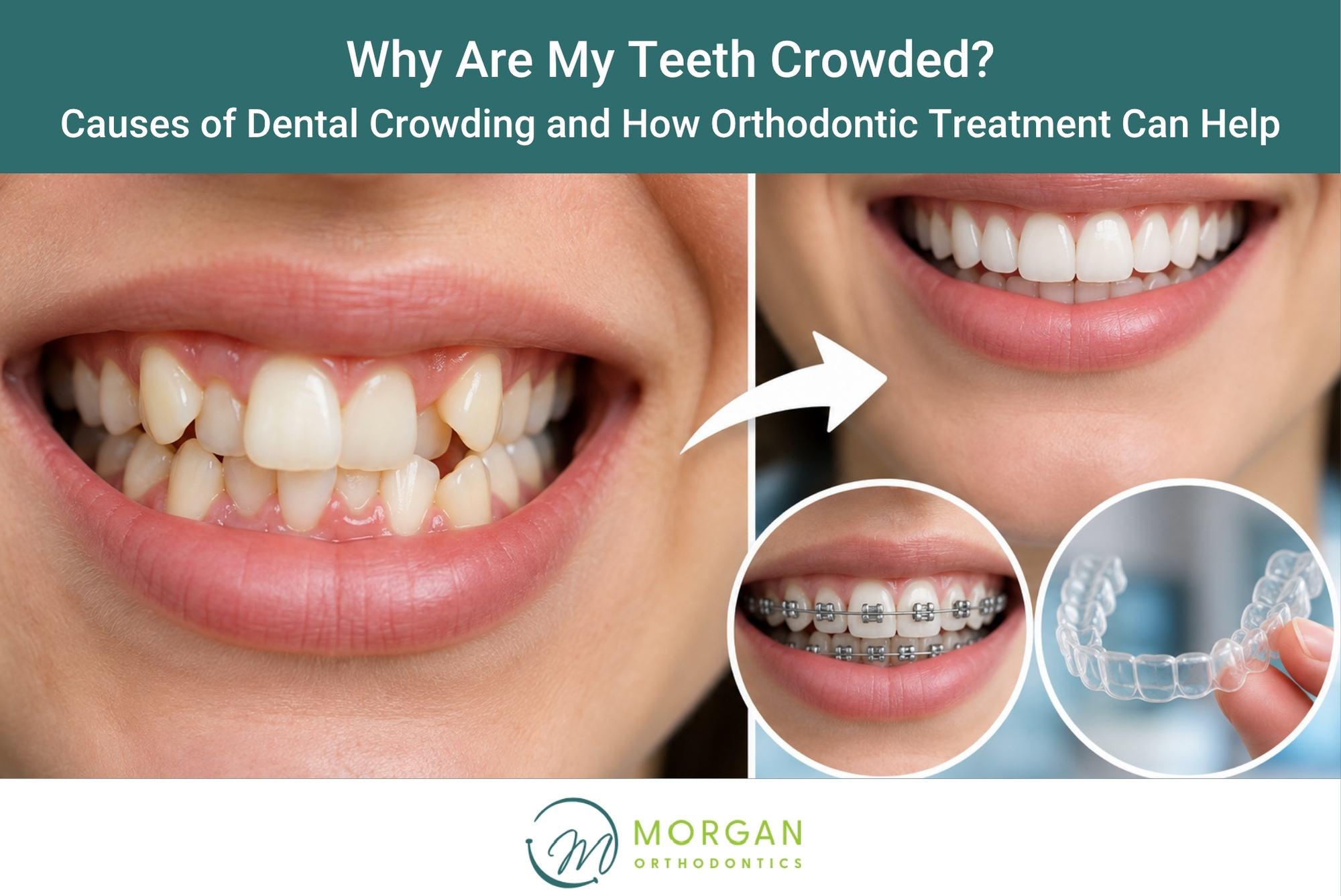
 Crowded teeth are one of the most common reasons children, teenagers, and adults seek orthodontic treatment. Dental crowding occurs when there is not enough room within the jaws for the teeth to align properly. As a result, teeth may overlap, rotate, erupt in the wrong position, or become trapped behind other teeth.
Although many people initially view crowded teeth as a cosmetic concern, crowding can also affect oral hygiene, bite function, gum health, and long-term dental stability. Teeth that overlap can create areas that are more difficult to brush and floss effectively, potentially allowing plaque and food debris to accumulate.
For patients searching for crowded teeth treatment in Northern Virginia, Morgan Orthodontics provides individualized orthodontic treatment at offices in Leesburg, Winchester, and Purcellville. Understanding why crowding develops is the first step toward determining the most appropriate way to create a healthier, more functional, and better-aligned smile.
What Are Crowded Teeth?
Dental crowding is a type of malocclusion, or improper tooth alignment, that develops when the available space in the dental arch is insufficient for the size or number of teeth.
Crowding can range from mild to severe. A person with mild crowding may have one or two slightly rotated or overlapping teeth. More significant crowding can cause several teeth to overlap, erupt outside the normal dental arch, or remain partially or completely impacted.
Crowding commonly affects the lower front teeth, but it can occur anywhere in the upper or lower dental arches.
What Causes Dental Crowding?
There is rarely a single explanation for every case of crowded teeth. Genetics, jaw development, tooth size, childhood oral development, and changes that occur over time can all contribute.
Genetics and Family History
Genetics can strongly influence the size and shape of the jaws as well as the size of the teeth. A person may inherit relatively large teeth, a smaller jaw, or a combination of characteristics that creates inadequate space for proper tooth alignment.
This is why dental crowding can appear in multiple members of the same family.
Differences Between Tooth Size and Jaw Size
One of the fundamental causes of crowding is a discrepancy between the amount of tooth structure and the amount of available jaw space.
If the teeth require more space than the dental arch provides, they may rotate, overlap, or erupt outside their ideal positions.
Early Loss of Baby Teeth
Primary, or baby, teeth serve an important role in maintaining space for permanent teeth.
When a baby tooth is lost earlier than expected because of decay, trauma, or another dental problem, neighboring teeth may gradually shift into the open space. This can reduce the amount of room available when the permanent tooth begins to erupt.
Retained Baby Teeth
The opposite situation can also contribute to alignment problems. A baby tooth that remains in place longer than expected may interfere with the normal eruption pathway of its permanent replacement.
An orthodontic evaluation can help determine whether retained primary teeth are affecting permanent tooth development.
Abnormal Tooth Eruption
Permanent teeth do not always erupt in ideal positions. Some may emerge at an angle, behind another tooth, toward the cheek or tongue, or outside the normal dental arch.
When eruption problems occur in an already limited amount of space, crowding can become more pronounced.
Missing or Extra Teeth
Variations in the number of teeth can influence spacing and alignment. Extra teeth may occupy space needed by the normal permanent teeth, while congenitally missing teeth can alter how surrounding teeth develop and migrate.
Orthodontic treatment planning takes these variations into consideration.
Changes in Tooth Alignment Over Time
Crowding is not limited to children and teenagers. Adults may notice that their lower front teeth gradually become more crowded as they age.
Teeth are not permanently fixed in one position throughout life. Natural changes in the supporting tissues, bite, and dental arches can contribute to shifting over time.
For this reason, orthodontic retention is an important part of maintaining results after treatment.
Why Crowded Teeth Can Be More Than a Cosmetic Concern
Straighter teeth can certainly improve the appearance of a smile, but orthodontic treatment is also concerned with function and long-term oral health.
Crowded Teeth Can Be More Difficult to Clean
Overlapping or rotated teeth can create narrow spaces that are difficult to reach with a toothbrush and dental floss.
When plaque is consistently left behind, the risk of tooth decay and gum inflammation may increase.
Correcting crowding can make the surfaces between and around teeth more accessible for routine oral hygiene.
Crowding May Affect Gum Health
When teeth erupt significantly outside the normal dental arch, the surrounding gum and supporting bone anatomy may differ from that around properly positioned teeth.
Orthodontists carefully evaluate the relationship between the teeth, gums, bone, and bite before recommending tooth movement.
Crowding Can Affect the Bite
Dental crowding sometimes occurs alongside other orthodontic problems, including overbite, underbite, crossbite, open bite, and abnormal tooth relationships.
Successful orthodontic treatment therefore involves more than simply making the front teeth appear straight. The entire bite must be evaluated.
Crowding May Cause Uneven Tooth Wear
Improperly positioned teeth can contact opposing teeth differently during biting and chewing. In some patients, these abnormal contacts may contribute to uneven wear.
Correcting tooth position and improving the bite can help distribute biting forces more appropriately.
How Orthodontists Evaluate Crowded Teeth
An orthodontic evaluation provides much more information than can be obtained by simply looking at the visible front teeth.
The orthodontist evaluates the teeth, jaws, bite, facial proportions, eruption patterns, and available space. Depending on the patient’s needs, diagnostic records may include photographs, digital scans, and radiographic imaging.
These records help answer important questions such as:
- How much crowding is present?
- Is there enough space for all permanent teeth?
- Are any teeth impacted or erupting abnormally?
- Is the crowding associated with a jaw or bite discrepancy?
- How much space needs to be created?
- Which treatment method can provide a stable and functional result?
A personalized diagnosis allows orthodontic treatment to address the underlying problem rather than simply the visible symptom.
How Can Orthodontic Treatment Fix Crowded Teeth?
The appropriate treatment depends on the patient’s age, severity of crowding, tooth and jaw anatomy, bite, and overall orthodontic goals.
There is no single crowded teeth treatment that is appropriate for every patient.
Braces for Crowded Teeth
Traditional braces remain a highly effective method of correcting mild, moderate, and complex dental crowding.
Brackets are attached to the teeth and connected by orthodontic wires. Controlled forces gradually guide the teeth toward planned positions.
Braces can simultaneously address crowding, rotations, spacing, and many bite problems.
Clear Aligners for Crowded Teeth
Clear aligner therapy may be appropriate for many teenagers and adults with crowded teeth.
A series of customized removable aligners progressively moves the teeth according to the treatment plan. Because aligners are removable, patients can take them out for eating, brushing, and flossing.
Successful aligner treatment requires consistent wear and appropriate case selection. An orthodontic evaluation is necessary to determine whether aligners are suitable for a particular patient’s crowding and bite.
Creating Additional Space
Correcting crowding requires enough room to position the teeth appropriately. Depending on the individual case, an orthodontist may create or redistribute space using several techniques.
These can include controlled tooth movement, arch development or expansion when appropriate, interproximal reduction in selected cases, and other orthodontic mechanics.
The method chosen depends on the patient’s anatomy and treatment objectives.
Does Crowding Always Require Tooth Extraction?
No. Many cases of crowded teeth can be successfully treated without removing permanent teeth.
However, extraction may be considered in certain cases involving significant space deficiency, tooth or jaw relationships, facial considerations, or other orthodontic factors.
The decision is highly individualized. An orthodontist must consider how creating space will affect the patient’s bite, tooth position, facial profile, periodontal health, and long-term stability.
Why Early Orthodontic Evaluation Can Be Helpful
Children do not need to wait until every permanent tooth has erupted before receiving an orthodontic evaluation.
Early evaluation allows an orthodontist to monitor jaw growth, permanent tooth eruption, available space, and developing bite problems.
Not every child with early crowding needs immediate orthodontic treatment. In many cases, observation is the most appropriate approach until the child reaches a particular stage of dental development.
When early intervention is indicated, however, treatment may help address specific developmental problems at a time when the jaws and teeth are still changing.
Can Adults Get Treatment for Crowded Teeth?
Yes. Orthodontic treatment is not limited to children and teenagers.
Adults frequently seek treatment because their teeth have always been crowded, because crowding has increased over time, or because they experienced orthodontic relapse after previous treatment.
As long as the teeth and supporting tissues are sufficiently healthy for orthodontic movement, adults may be candidates for braces, clear aligners, or other treatment approaches.
Patients with periodontal disease, extensive restorative dentistry, missing teeth, or other dental concerns may benefit from coordinated care between their orthodontist and general dentist or other dental specialists.
How Long Does Treatment for Crowded Teeth Take?
Treatment time varies considerably.
Mild crowding may require less treatment time than a complex case involving severe rotations, impacted teeth, significant bite problems, or major space discrepancies. Treatment duration also depends on the type of orthodontic appliance, biological response to tooth movement, patient cooperation, and treatment objectives.
After examining the teeth and bite, an orthodontist can provide a more individualized estimate.
Why Retainers Matter After Crowding Is Corrected
Correcting crowded teeth is only part of successful orthodontic care. Maintaining the new positions is equally important.
Teeth have a natural tendency to shift after orthodontic treatment. Retainers help preserve alignment while the tissues surrounding the teeth adapt to their new positions.
Long-term retainer wear, according to the orthodontist’s instructions, is one of the most important ways to reduce the likelihood of orthodontic relapse.
Crowded Teeth Treatment in Northern Virginia
Dental crowding is highly treatable, but successful orthodontic care begins with an accurate diagnosis.
At Morgan Orthodontics, treatment planning considers more than the appearance of individual teeth. The goal is to understand how tooth position, available space, jaw relationships, and bite function interact so that treatment can be tailored to the individual patient.
For children, teenagers, and adults considering crowded teeth treatment in Northern Virginia, an orthodontic consultation can help determine the cause and severity of crowding and identify appropriate treatment options.
With offices in Leesburg, Winchester, and Purcellville, Morgan Orthodontics provides convenient orthodontic care for families throughout Northern Virginia.
Frequently Asked Questions About Crowded Teeth
Why are my teeth crowded?
Crowding usually develops because there is not enough space in the dental arch for the teeth to align properly. Genetics, tooth size, jaw size, early or delayed loss of baby teeth, eruption patterns, and other developmental factors can contribute.
Do crowded teeth get worse with age?
They can. Tooth position can change throughout adulthood, and some people notice increasing crowding—particularly among the lower front teeth—as they get older.
Are crowded teeth unhealthy?
Crowded teeth are not automatically unhealthy, but overlapping and rotated teeth can make effective brushing and flossing more difficult. This may increase plaque retention and contribute to cavities or gum inflammation in difficult-to-clean areas.
Can braces fix severely crowded teeth?
Yes, braces can treat many levels of dental crowding, including complex cases. The exact treatment approach depends on the amount of space required and whether additional bite or jaw problems are present.
Can clear aligners fix crowded teeth?
Clear aligners can successfully correct many cases of dental crowding. However, not every type of crowding is equally suited to aligner therapy. An orthodontist can determine whether clear aligners, braces, or another treatment approach is most appropriate.
Will I need teeth removed because of crowding?
Not necessarily. Many patients can be treated without permanent tooth extraction. Extractions may be recommended in selected cases when significant space is required or when removal supports better overall tooth, bite, or facial relationships.
Can crowded teeth be fixed without braces?
In some cases, clear aligners provide an alternative to traditional braces. The best option depends on the severity and type of crowding as well as the patient’s bite and treatment goals.
Can crowded teeth cause cavities?
Crowding does not directly cause cavities. However, overlapping teeth can create areas that are harder to clean thoroughly. If plaque remains in these areas, the risk of tooth decay may increase.
Can crowded teeth cause gum problems?
Crowded or abnormally positioned teeth can make plaque control more challenging, which may contribute to gum inflammation. The periodontal tissues surrounding significantly displaced teeth also need to be considered during orthodontic treatment planning.
At what age should a child with crowded teeth see an orthodontist?
Children can benefit from an orthodontic evaluation while their teeth and jaws are still developing. An early assessment does not necessarily mean immediate treatment. It allows the orthodontist to monitor development and recommend treatment at the most appropriate time if intervention becomes necessary.
Am I too old to straighten crowded teeth?
There is no universal upper age limit for orthodontic treatment. Many adults successfully undergo orthodontic care. The health of the teeth, gums, bone, and supporting structures is generally more important than chronological age.
How long will it take to straighten crowded teeth?
Treatment time depends on the severity of the crowding, bite complexity, treatment method, biological response, and patient cooperation. A personalized orthodontic examination is necessary to estimate treatment duration accurately.
Will my teeth stay straight after orthodontic treatment?
Retainers are essential for maintaining orthodontic results. Without appropriate retention, teeth can gradually shift. Following the prescribed retainer schedule helps protect the alignment achieved during treatment.
When should I schedule an orthodontic consultation?
Consider an evaluation if you or your child has overlapping teeth, rotated teeth, teeth erupting outside the normal arch, difficulty cleaning between teeth, or concerns about the bite or appearance of the smile. An orthodontic consultation can determine whether treatment is recommended now or whether monitoring is appropriate.
Schedule an Orthodontic Consultation with Morgan Orthodontics
Crowded teeth are common, but every patient’s underlying anatomy and orthodontic needs are different. Determining why the teeth are crowded—and how much space is needed to correct them—is essential for developing an appropriate treatment plan.
If you are looking for crowded teeth treatment in Northern Virginia, Morgan Orthodontics offers orthodontic evaluations and individualized treatment options for children, teens, and adults.
Contact Morgan Orthodontics to schedule a consultation and learn which approach may be appropriate for creating a healthier, properly aligned, and confident smile.
Contact Information
Morgan Orthodontics
Leesburg Office
19420 Golf Vista Plaza, Ste. 120
Leesburg, VA 20176
Phone: 703-723-5900
Winchester Office
1841 West Plaza Dr.
Winchester, VA 22601
Phone: 540-667-5446
Purcellville Office
610 E Main Street
Purcellville, VA 20132
Phone: 540-338-8125
Website: morganorthodontics.com
Call Us: (703) 723-5900